
You’ve probably seen a sentence end with “pun intended” tucked in parentheses, right after a clever double meaning. That small phrase is doing a specific job: it tells the reader the wordplay was on purpose, not an accident. This guide breaks down exactly what “pun intended” means, where the phrase comes from, how it compares to “no pun intended,” and how to use it naturally in your own writing and conversation. Along the way, you’ll find 20 example sentences that show the phrase in action across everyday situations.
What Does “Pun Intended” Mean?
“Pun intended” is a short phrase writers and speakers add after a pun to confirm the wordplay was deliberate. It signals that the double meaning in the sentence wasn’t a slip of the tongue — the person knew exactly what they were doing and wants the audience to catch it too.
Quick Answer: “Pun intended” means the pun in the sentence was made on purpose, and the speaker wants you to notice it.
Simple Definition
When someone says or writes “pun intended,” they’re pointing at a word or phrase they just used that carries two meanings at once. The math teacher’s dating life just doesn’t add up, pun intended. Here, “add up” works both as a math phrase and as a comment on a confusing relationship, and the tag confirms the double meaning was intentional.
What Is a Pun? Understanding Wordplay First
A pun is a form of wordplay that uses a word’s multiple meanings, or two words that sound alike, to create a humorous or clever effect. Puns have shown up in literature and everyday speech for centuries, and they rely on the listener catching both meanings at once — the expected one and the hidden one.
Types of Puns
Puns generally fall into a few recognizable categories.
Homophonic puns use words that sound alike but are spelled differently and mean different things. For example: Seven days without pasta makes one weak. Here, “weak” sounds identical to “week,” and the sentence only works because both meanings land at the same time.
Homographic puns use one word that’s spelled the same but carries two different meanings depending on context. For example: The electrician’s jokes never fail to shock everyone. “Shock” refers to both an electrical shock and a surprised reaction, and the electrician’s profession makes both readings active at once.
Compound puns stack more than one piece of wordplay into a single sentence. For example: The origami artist’s business folded, but he’s trying to paper over the losses. This uses two separate puns — “folded” (origami folding and business failure) and “paper over” (literal paper and covering up a problem) — working together in one line.
Recognizing these categories makes it easier to spot what kind of pun you’re dealing with, whether you’re writing one or just noticing one in the wild.
Where Does “Pun Intended” Come From?
The Origin of the Word “Pun”
The word “pun” itself dates back to the 1600s. Its exact roots are uncertain, but many language historians believe it developed from an Italian term related to puntiglio, meaning a fine point or a trivial quibble, which in turn traces back to a Latin word for “point.” By the late 1600s, “pun” had settled into English as the word for this specific kind of wordplay, and it has kept that meaning ever since.
How “Pun Intended” Became Common Usage
Wordplay itself is ancient, appearing in the writings of Greek and Roman authors long before English existed. The specific habit of flagging a pun with a short parenthetical comment is much newer. Its counterpart, “no pun intended,” is the better-documented of the pair — one commonly cited early example comes from a 19th-century story describing a turkey’s antics as “fowl play,” with the pun flagged directly afterward. As puns became a fixture of casual writing, comedy, and journalism through the 20th century, “pun intended” emerged as the natural positive counterpart: instead of disclaiming the wordplay, it owns it. Today both phrases are common in everyday English, from casual conversation to published news writing.
How to Use “Pun Intended” in a Sentence
Placement
“Pun intended” almost always comes immediately after the pun, either inside parentheses or as a short standalone clause. This new mattress store really knows how to spring into action, pun intended. Placing it right after the wordplay keeps the connection clear for the reader.
In Written English
In writing, “pun intended” works as a signal flag, especially when the double meaning might otherwise slip past the reader. The plumber’s memoir was called “Under Pressure,” pun intended. Here, the phrase clarifies that the title’s double meaning — literal water pressure and the pressure of daily work — was chosen on purpose.
In Spoken English
In conversation, tone of voice usually makes a pun obvious without needing to say anything extra. Still, people sometimes add the phrase for emphasis or comic timing. After I fixed the leaky faucet, I told my roommate the plumbing crisis had been drained of all its drama, pun intended. Saying the phrase out loud here adds a small beat of humor that a raised eyebrow alone might not deliver.
Is “Pun Intended” Grammatically Correct?
Yes. “Pun intended” is a shortened form of a longer sentence, such as “the pun was intended,” with the subject and verb dropped for brevity. This kind of clipped, parenthetical phrasing is common in English and is considered standard, accepted usage in both casual and semi-formal writing.
20 Pun Intended Examples
- The locksmith’s business really opened new doors, pun intended.
- The baker’s shop has been on a roll ever since it opened, pun intended.
- The electrician’s new light fixtures really lit up the room, pun intended.
- The gardener’s landscaping company is finally taking root in the neighborhood, pun intended.
- The fisherman’s new tackle shop is seeing some serious net gains, pun intended.
- The optometrist and her patients finally saw eye to eye, pun intended.
- The dairy farmer’s new app really milks the data for useful insights, pun intended.
- The tailor stayed sew calm under pressure during the busy holiday season, pun intended.
- The weather forecaster got a storm of compliments after last night’s broadcast, pun intended.
- The retired boxer took a swing at a new career in coaching, pun intended.
- The orchestra’s new conductor is really conducting himself well this season, pun intended.
- The photographer said the internship really developed her talent, pun intended.
- The coffee shop’s slow morning gave the staff grounds for concern, pun intended.
- The city planner’s new park design is full of perfect squares, pun intended.
- The dentist always gets right to the crown of the issue, pun intended.
- The astronomer’s new theory is truly out of this world, pun intended.
- The banker’s new relationship is already showing serious compound interest, pun intended.
- The chef’s years in the kitchen have made him a seasoned professional, pun intended.
- The track coach said her comeback story really had legs, pun intended.
- The muralist really knows how to draw a crowd downtown, pun intended.
“Pun Intended” vs. “No Pun Intended”: What’s the Difference?
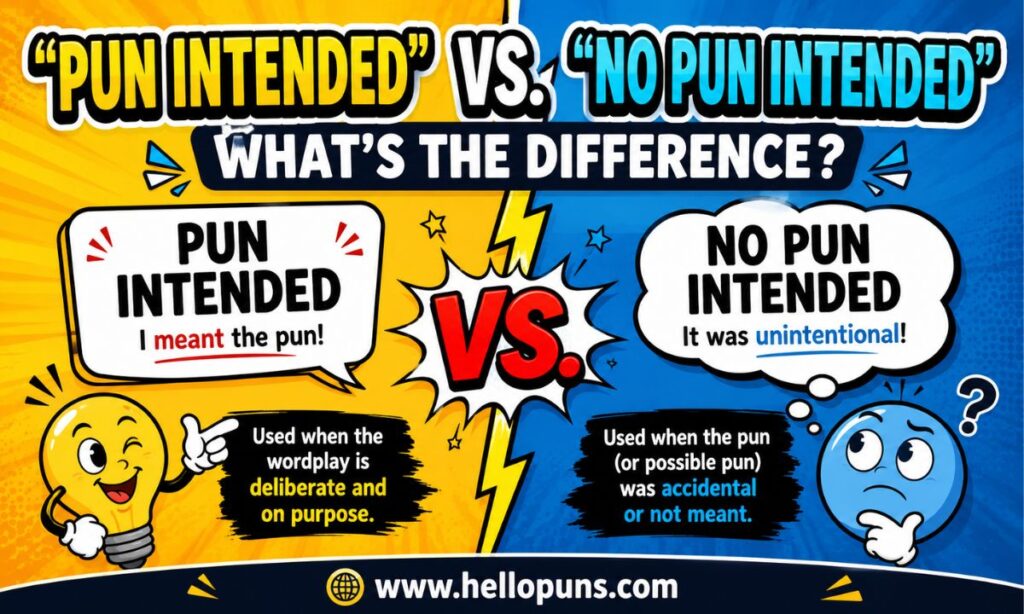
These two phrases look almost identical, but they signal opposite intentions.
Pun Intended
“Pun intended” confirms that the wordplay in a sentence was deliberate. The chef’s new soup recipe really stirred things up around the office, pun intended. The speaker is proud of the double meaning and wants it noticed.
No Pun Intended
“No pun intended” is used when a word or phrase accidentally creates a double meaning, and the speaker wants to clarify they weren’t trying to be clever. I need to get straight to the point about this pencil order, no pun intended. Here, “point” has an unplanned double meaning, and the speaker is heading off any confusion.
Quick Comparison
| Pun Intended | No Pun Intended | |
| Wordplay | Deliberate | Accidental (or claimed to be) |
| Purpose | Highlights the joke | Clarifies there wasn’t one |
| Tone | Playful, self-aware | Apologetic or clarifying |
What Does “Pun Intended, Perhaps” Mean?
Adding “perhaps” to the phrase introduces a bit of playful uncertainty. That firefighter’s speech about extinguishing doubt was pretty on fire, pun intended, perhaps. The word “perhaps” lets the speaker hint at the pun without fully committing to having planned it, which can come across as either modest or a little sarcastic depending on the context.
Alternatives to Saying “Pun Intended”
There are a few other common ways to flag a pun instead of repeating the same phrase every time.
If You’ll Pardon the Pun — The clockmaker’s new shop is, if you’ll pardon the pun, perfectly timed.
Excuse the Pun / Forgive the Pun — Excuse the pun, but the bricklayer really built his career from the ground up.
Wordplay Intended — Wordplay intended: the crossword designer’s puzzles are always a good fit.
Each of these works the same way as “pun intended,” acknowledging the wordplay while adding a bit of variety so the phrase doesn’t feel repetitive across a piece of writing.
Why Do People Say “Pun Intended”?
Social Signaling of Humor — It shows the audience that the speaker is aware of language and enjoys playing with it.
Avoiding Confusion — Some puns are subtle enough that a reader might miss them entirely without a nudge.
Enhancing Wit — Pointing out the wordplay reinforces just how clever the line was meant to be.
Building Rapport — Shared humor, even a groan-worthy pun, creates a small moment of connection between speaker and listener.
Can a Pun Be Unintentional?
Yes. Because so many English words carry more than one meaning, it’s easy to create a pun without meaning to. Someone announcing budget cuts might not notice that “cut” carries a second, sharper meaning until someone else points it out. In cases like this, the speaker typically follows up with “no pun intended” rather than “pun intended,” since the double meaning wasn’t planned in the first place.
“Pun Intended” vs. Double Entendre: What’s the Difference?
A pun and a double entendre are related, but they aren’t the same thing. A pun is any wordplay built on multiple meanings or similar-sounding words, and it can be about anything — food, work, weather, hobbies. A double entendre is a specific kind of pun where one of the two meanings carries a slightly suggestive or risqué undertone, while the other meaning stays completely innocent on the surface. In other words, every double entendre is technically a pun, but most puns are not double entendres. “Pun intended” can be used after either type, but it’s most often associated with the lighter, non-suggestive kind of wordplay covered throughout this article.
Is Saying “Pun Intended” Rude or Clever?
Most of the time, “pun intended” reads as lighthearted and clever rather than rude. Context is what determines whether it lands well.
Appropriate Contexts
- Casual conversations with friends or family
- Social media captions and posts
- Blog posts, newsletters, and other informal writing
- Relaxed workplace communication, like team chats
Situations to Avoid
Formal writing is where “pun intended” tends to fall flat. Academic papers, legal documents, official reports, and serious professional communication generally call for a more neutral tone, and dropping in a pun tag can come across as out of place. The same goes for genuinely serious or sensitive topics, where humor of any kind — puns included — can feel misjudged.
Using It Without a Real Pun
One common misstep is tacking “pun intended” onto a sentence that doesn’t actually contain a double meaning. Without a genuine pun behind it, the phrase loses its purpose and just sounds like filler. It’s worth double-checking that the word or phrase in question truly carries two meanings before flagging it this way. Overusing the phrase across every sentence in a piece of writing causes the same problem — it stops feeling clever and starts feeling like a tic.
“Pun Intended” in Literature and Everyday Media
Wordplay has a long history in English literature. William Shakespeare used puns constantly, even in serious moments. In Romeo and Juliet, the dying Mercutio jokes, “Ask for me tomorrow, and you shall find me a grave man,” playing on “grave” as both “serious” and “buried.” Oscar Wilde built an entire play around a pun with The Importance of Being Earnest, where the name “Earnest” doubles as the quality of being sincere. Modern journalism keeps the tradition alive, too — news and entertainment writers regularly work a pun into a headline or a closing line and flag it with “pun intended” when the wordplay might otherwise go unnoticed.
Frequently Asked Questions
What does “pun intended” mean?
It means the speaker or writer deliberately used a pun and wants the audience to notice the wordplay rather than assume it was accidental.
How do you use “pun intended” in a sentence?
Place it right after the sentence or phrase containing the wordplay, usually in parentheses or as a short standalone clause, so the connection to the pun stays clear.
Is “pun intended” grammatically correct?
Yes. It’s a shortened form of a longer sentence like “the pun was intended,” and this kind of clipped phrasing is standard in everyday English.
What is the opposite of “pun intended”?
“No pun intended” is the opposite. It clarifies that a double meaning in a sentence was accidental rather than planned.
Where did the phrase “pun intended” come from?
Its exact origin isn’t precisely documented, but it developed as the positive counterpart to “no pun intended,” which has been traced back to at least the 19th century in English writing.
Is “pun intended” the same as “no pun intended”?
No. They look similar but mean opposite things: one confirms the wordplay was on purpose, and the other claims it wasn’t.
What’s the difference between a pun and a double entendre?
A pun is any wordplay based on multiple meanings or similar sounds. A double entendre is a specific type of pun where one of the two meanings has a suggestive undertone.
What can I say instead of “pun intended”?
Common alternatives include “if you’ll pardon the pun,” “excuse the pun,” “forgive the pun,” and “wordplay intended.”
Final Thoughts
“Pun intended” is a small phrase with a clear job: it tells your reader or listener that the wordplay they just caught was no accident. Understanding where it comes from, how it compares to “no pun intended,” and when it fits a given context makes it much easier to use naturally instead of as a reflex. Once you can spot the difference between a pun, a double entendre, and an unintentional double meaning, the phrase starts to feel like a genuinely useful tool rather than just a habit.
Whether you’re writing a caption, telling a joke among friends, or just want to give a clever line its proper credit, a well-placed “pun intended” does exactly what it’s meant to do. Used sparingly and only when there’s a real pun behind it, the phrase keeps its charm instead of wearing it out. It’s a small addition, but it makes your writing feel more deliberate and self-aware.

Hey, I’m Theo Banter. With over 4 years of experience in the world of digital storytelling and wordplay, I’ve dedicated my career to the art of the ‘perfect pun.’ I created this little corner of the internet where words love to play, turning simple ideas into clever lines that make readers smile. My mission is simple: if I can make you laugh (or at least groan!), I’ve done my job. Welcome to the freshest humor on the web