
Making a good pun feels like magic when you don’t know how it’s done, but it’s actually a skill you can learn in an afternoon. This guide breaks down what a pun really is, the different techniques punsters use to build one, and a simple five-step process you can follow with almost any word or topic. Along the way, you’ll find original examples, common mistakes to avoid, and a practice bank you can borrow from right away.
What Is a Pun, Exactly?
A pun is a play on words that gets its humor from a word or phrase having more than one meaning, or from two different words that sound alike. The joke works because your brain catches both meanings at once, and that little jolt of double recognition is what makes you laugh (or groan).
Pun vs. Dad Joke: Are They the Same Thing?
Puns and dad jokes overlap a lot, but they aren’t identical. A pun always depends on wordplay: a double meaning, a sound-alike word, or a shared spelling. A dad joke is broader — it can be a pun, but it can also be a simple, corny setup-and-punchline joke with no wordplay at all. In short, every pun can be a dad joke, but not every dad joke is a pun.
The Building Blocks: Types of Puns You Can Use
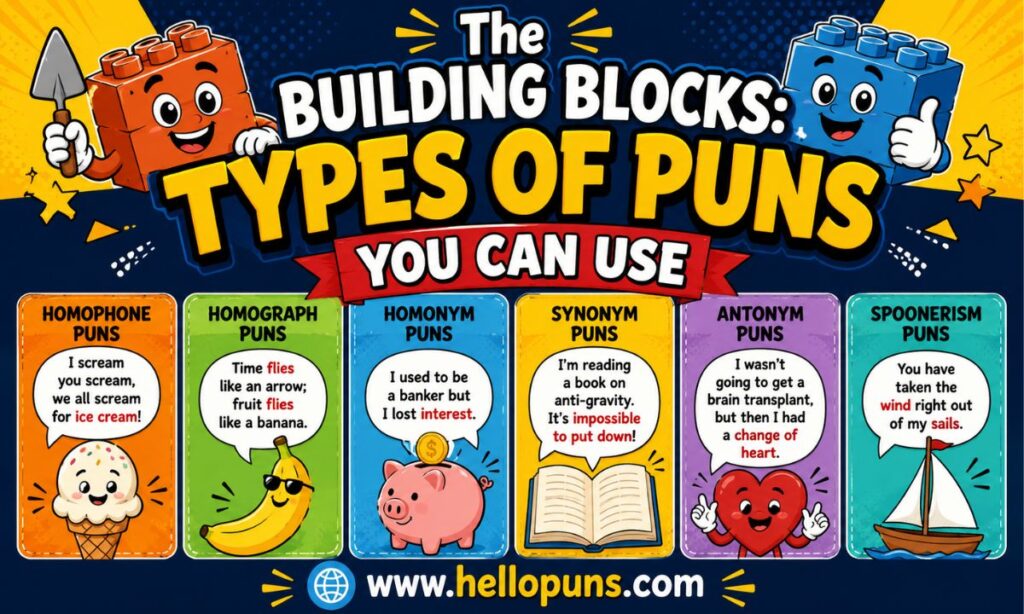
Before you can build a pun on purpose, it helps to know the handful of techniques that make one work. These aren’t just labels for English class — they’re your actual toolkit.
Homophonic Puns (Sound-Alike Words)
A homophonic pun swaps in a word that sounds like another word, so the sentence works two ways at once.
- The baker stopped making bread because he kneaded a break.
Wordplay: “kneaded” sounds like “needed,” so the line means both “he required a rest” and “he was done pressing dough.”
Homographic Puns (Same Spelling, Different Meaning)
A homographic pun uses one word that’s spelled and said the same way but carries two different meanings.
- The archer’s jokes always miss the mark, but at least his arrows don’t.
Wordplay: “miss the mark” means both “fail to land” (the jokes) and “fail to hit the target” (the arrows), using the same phrase in two literal senses.
Compound Puns (Two or More Puns in One Line)
A compound pun packs multiple wordplay moments into a single sentence.
- The tailor refused to gossip because he didn’t want to make a scene or sew any seeds of doubt.
Wordplay: this line stacks “scene/seen” alongside “sew/so,” pairing two sets of sound-alike words in one joke.
Recursive Puns (Puns That Need a Setup to Land)
A recursive pun only works if the reader already understands a reference baked into the first half.
- Every calendar’s days are numbered, but January’s are just getting started.
Why It Works: the phrase “days are numbered” (usually meaning “running out of time”) only lands as a second joke once you realize a calendar literally numbers its days — you need the common phrase in mind before the twist makes sense.
Visual Puns (When the Joke Is in the Image, Not the Words)
A visual pun uses a picture, logo, or symbol instead of spoken words to carry the double meaning — think of a moving company using a logo shaped like a box with legs, or a coffee shop sign shaped like a steaming cup that doubles as a smiling face. These are common in advertising and comics, and they rely on the same “two meanings at once” idea, just expressed visually instead of verbally.
How to Make a Pun in 5 Simple Steps
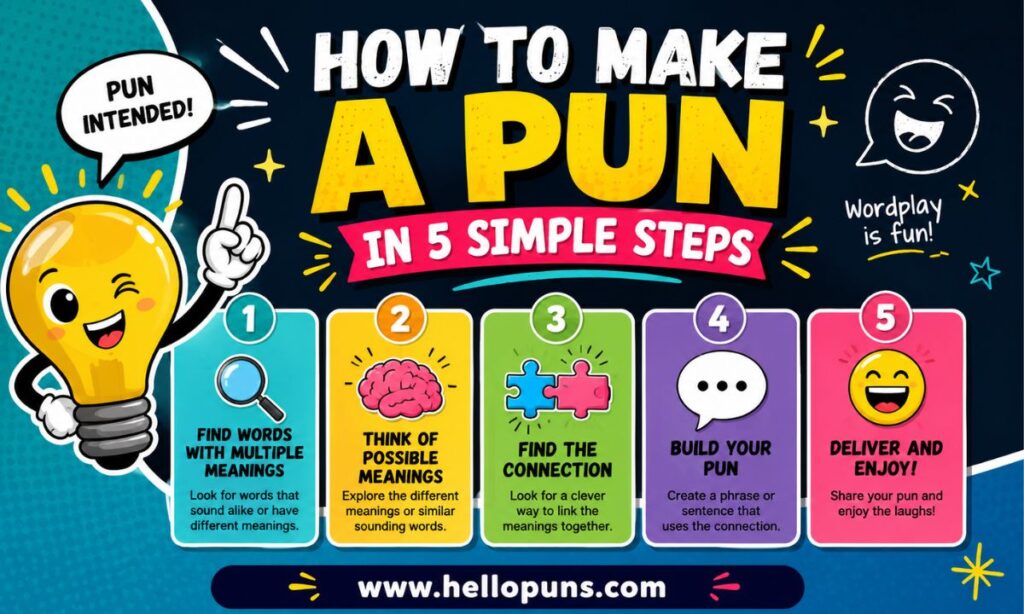
Here’s the actual process, using the word “bread” as a running example so you can see how each step builds on the last.
- Pick your topic or target word. Choose something concrete and short — a noun works best. For this example, we’ll use “bread.”
- Brainstorm sound-alikes and double meanings. List words that sound like your target or that share a phrase with it. “Bread” sounds close to “bred,” and it also has a slang meaning (“money”). Write down every option, even the weak ones.
- Build the setup around the wordplay. Pick the strongest option and build an ordinary-sounding sentence that naturally uses both meanings. Using the money angle: “The baker was rolling in dough” already works as a common phrase, so push it further — “The baker became a loan officer because he knew how to make dough.”
- Say it out loud (the read-aloud test). Puns live or die on how they sound, not how they look on paper. Read your line aloud. If a listener would need the sentence repeated to catch the joke, the sound-alike isn’t close enough.
- Trim it until only the joke is left. Cut extra words that don’t support the punchline. Our working line becomes: “He left banking to open a bakery — he still knows how to make dough.”
That’s the whole process: pick a word, gather sound-alikes, build a natural sentence around the best one, test it aloud, then trim.
Try It Yourself: A Quick Pun-Building Exercise
Grab any everyday object near you right now — a chair, a phone, a coffee mug — and run it through the same five steps. Write down three words that sound like it or relate to it, pick the strongest one, and build one plain sentence that could honestly work both ways. Read it out loud before you decide if it’s a keeper. Most punsters find that their third or fourth attempt on a new word is usually the one that actually lands.
Tools and Tricks Real Punsters Use
Homophone and Rhyming Word Lists: Keeping a running list of sound-alike word pairs (like “flour/flower” or “night/knight”) speeds up brainstorming, since you won’t have to think of them from scratch every time.
The Phrase-Substitution Method: Start with a common saying or title you already know, then swap in a similar-sounding word tied to your topic. This is how many movie-title and headline puns get built, and it’s faster than starting from a blank page.
Building Your “Pun Vocabulary”: The more words and idioms you actively know, the more raw material you have to work with. Reading widely and paying attention to common expressions gives you a bigger mental list to pull sound-alikes from.
When (and Where) Puns Actually Work
Great Moments for a Pun
Puns tend to land well as icebreakers, in captions, on greeting cards, in casual conversation, and anywhere a light, silly tone is welcome.
When to Hold Back
Puns can undercut a serious tone, so it’s worth skipping them in formal writing, during genuinely difficult conversations, or in any moment where the audience is looking for sincerity rather than wit.
Common Pun-Making Mistakes to Avoid
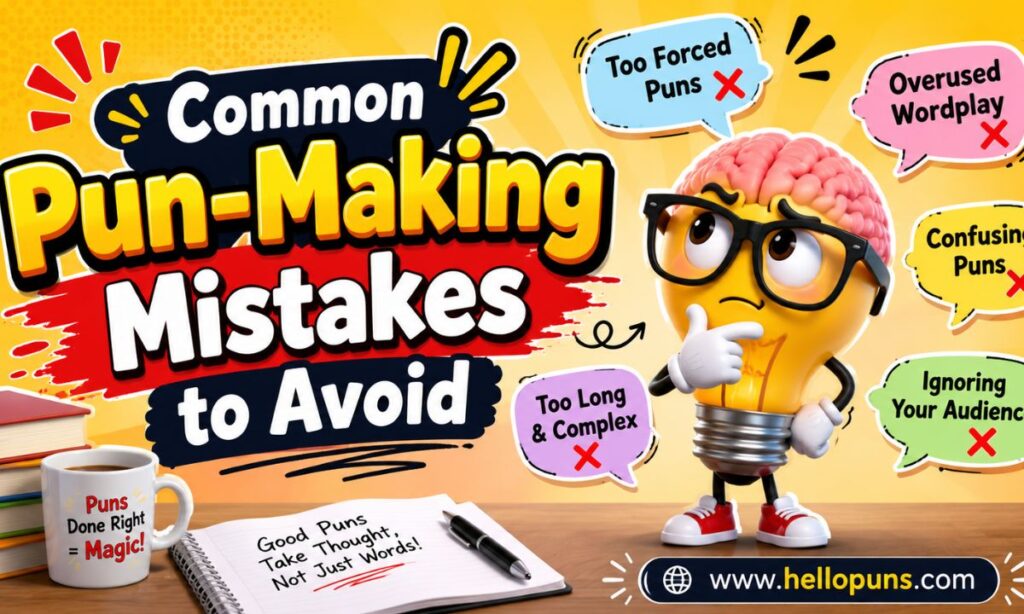
- Forcing the wordplay. If you have to stretch a word’s pronunciation too far, the joke stops being clever and starts being confusing.
- Over-explaining the joke. Adding “get it?” after a pun kills the payoff — trust the listener to catch it.
- Stacking too many puns in a row. One strong pun lands better than five weak ones crammed into the same sentence.
- Choosing long or rare words. Short, common words are easier to twist and easier for listeners to recognize instantly.
- Ignoring how it sounds out loud. A pun that only works on paper usually fails in conversation.
Why Do Puns Make People Groan? (And Why That’s the Point)
Puns have a strange reputation: they get a bigger reaction than almost any other joke type, but the reaction is often a groan rather than a laugh. Sigmund Freud once argued that puns rank as one of the lowest forms of wit, mainly because they’re so easy to produce compared with more complex humor. Other writers have pushed back on that idea entirely, arguing that puns actually represent a high form of wit, since they force the brain to hold two unrelated meanings together at the same time and find the connection surprising rather than obvious.
The groan itself is part of the appeal. It’s an involuntary response to realizing you’ve been tricked by language in a harmless way, and that mix of appreciation and mild annoyance is exactly why puns get shared, repeated, and groaned at for generations.
Example Puns for Each Technique (Practice Bank)
- I used to be a florist, but the job didn’t pan out — turns out I’m better suited to thyme management.
- The electrician’s marriage was shocking at first, but eventually they found their current.
- A calendar maker never gets bored; there’s always another date on the horizon.
- The locksmith’s autobiography didn’t sell well — critics said the plot needed a few more twists.
- My blanket business finally took off once I started making the right coverage decisions.
- The astronomer broke up with her boyfriend because he needed too much space.
- A window cleaner’s favorite subject in school was always something to reflect on.
- The baker’s new hire had incredible instincts — a real rising star.
- My gardening podcast never took off; I guess the audience just wasn’t growing.
- The clockmaker’s shop always runs on time, mostly because he minds his own business.
Frequently Asked Questions
What exactly is a pun?
A pun is a joke built on a word or phrase having more than one meaning, or on two words that sound alike, so a single line can be read two ways at once.
What’s the easiest type of pun to start with?
Homophonic puns are usually the easiest for beginners, since you only need to find one sound-alike word pair and build a sentence around it.
Do I need a big vocabulary to make good puns?
It helps, but it isn’t required. Many strong puns use short, everyday words rather than obscure ones, so paying close attention to common phrases matters more than knowing rare vocabulary.
What tools can help me think of puns faster?
A running list of homophones, a habit of noticing common idioms, and the phrase-substitution method (starting from a familiar saying and swapping in a related word) all speed up the process.
Why do people groan at puns instead of laughing?
The groan is a reaction to realizing you’ve been caught off guard by wordplay. It’s considered a sign the joke worked, even though it isn’t a traditional laugh.
Is there a difference between a pun and a dad joke?
Yes. A pun always relies on wordplay, while a dad joke is a broader category that can use wordplay or simply a plain, corny setup and punchline.
How do I make a pun about a specific topic, like coffee or Mondays?
Start with words closely tied to that topic, list any sound-alikes or double meanings connected to them, then build a plain sentence around the strongest option before trimming it down.
Can puns work in serious or formal writing?
Occasionally, but sparingly. A single well-placed pun can lighten a moment, but repeated puns usually clash with a formal or serious tone.
How many puns are too many in one conversation or piece of writing?
There’s no fixed number, but stacking several puns back to back usually weakens each one. One strong, well-timed pun beats several rushed ones.
What’s a compound pun, and how is it different from a regular one?
A compound pun contains two or more separate pieces of wordplay in a single sentence, while a regular pun usually relies on just one double meaning or sound-alike pair.
Final Thoughts
Making a pun comes down to a repeatable process: pick a word, find its sound-alikes or double meanings, build a natural sentence around the strongest option, and trim it until only the joke remains. Knowing the different types of puns gives you more tools to reach for, and reading your lines out loud is the fastest way to tell if a joke actually lands.
Like any skill, punning gets easier the more you practice it on ordinary words around you. Give yourself permission to write a few weak attempts before you land a good one, since even seasoned punsters rarely nail it on the first try. The next everyday object you notice might just be your next pun waiting to happen.

Hey, I’m Theo Banter. With over 4 years of experience in the world of digital storytelling and wordplay, I’ve dedicated my career to the art of the ‘perfect pun.’ I created this little corner of the internet where words love to play, turning simple ideas into clever lines that make readers smile. My mission is simple: if I can make you laugh (or at least groan!), I’ve done my job. Welcome to the freshest humor on the web