
A pun is one of the simplest ways to make language funny, and a well-placed one can turn an ordinary sentence into something memorable. This guide collects 150 pun examples, sorted from quick one-liners to sentence puns, major pun types, topic-based collections, literary examples, and classroom-ready lines for students.
Along the way, you’ll find a clear definition of what actually counts as a pun, the difference between a pun and a joke or double entendre, and a simple method for writing your own.
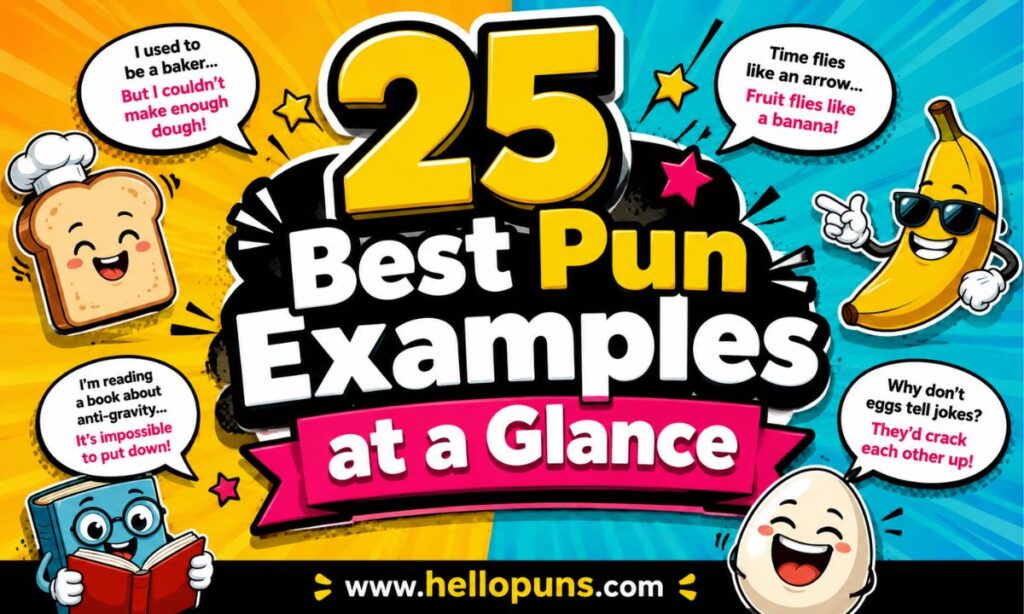
25 Best Pun Examples at a Glance
- I used to be a banker, but I lost interest.
- The bicycle couldn’t stand up on its own — it was two-tired.
- A calendar’s days are numbered.
- The cheese factory in France exploded. There was nothing left but de Brie.
- I’m on a seafood diet: I see food, and I eat it.
- The scarecrow won an award for being outstanding in his field.
- The baker stopped kneading dough because business got too kneady.
- The electrician was let go from his job, but he was shocked at the decision.
- The golfer packed two pairs of pants in case he got a hole in one.
- The mattress store’s profits kept springing back every spring.
- A boiled egg every morning is hard to beat.
- The math teacher’s favorite dessert is pi.
- I wondered why the ball kept getting bigger, and then it hit me.
- The dentist and the manicurist fought tooth and nail over the schedule.
- The optometrist made a real spectacle of himself.
- The chicken farmer said business was eggcellent this year.
- The gym down the street closed because it just couldn’t work out.
- The astronomer couldn’t finish dinner because he ran out of space.
- The plumber’s jokes are always on tap.
- The pizza delivery man went out of business — he just couldn’t make enough dough.
- The energy drink company generated a lot of buzz this quarter.
- The lumberjack’s favorite subject in school was logarithms.
- The window installer’s business really pane out.
- The clock in the break room is always ticking someone off.
- A pastry chef’s life is filled with just desserts.
Why a few of these work: “De Brie” plays on the French cheese Brie and the word debris. “Kneady” swaps in for needy while still describing what a baker does. “Eggcellent” blends egg into excellent to fit the chicken-farming context. “Pane out” swaps pain for pane, a term for a sheet of window glass.
What Is a Pun?
A Simple Definition of a Pun
A pun is a figure of speech that creates humor, emphasis, or surprise by exploiting a word’s multiple meanings, or by using two different words that sound the same or nearly the same. Puns are also called paronomasia, and they’ve been part of written and spoken language for thousands of years, appearing everywhere from ancient wordplay to modern advertising slogans.
How a Pun Creates Two Meanings
Every genuine pun depends on ambiguity. The reader or listener processes the obvious, literal meaning first, then a second meaning surfaces — either because the same word carries two definitions or because a different word with a similar sound fits the context. That gap between the expected meaning and the surprising one is where the humor comes from.
| Example | Wordplay | Meanings | Type |
| The banker lost interest. | interest | attention / money earned from a bank | Homonymic |
| The bicycle was two-tired. | two-tired / too tired | two tires / exhausted | Homophonic |
| A calendar’s days are numbered. | numbered | counted / running out | Homonymic |
Pun vs Wordplay, Joke, Double Entendre, and Malapropism
- Pun vs. wordplay: A pun is a specific type of wordplay. Wordplay is the broader category and also includes spoonerisms, tongue twisters, and anagrams.
- Pun vs. joke: A joke is any structured piece of humor built around a setup and punchline. A pun can be part of a joke, but plenty of jokes contain no wordplay at all.
- Pun vs. double entendre: A double entendre is a phrase with two interpretations, where one is typically suggestive or risqué. Puns rely on sound or spelling; a double entendre relies on context and innuendo.
- Pun vs. malapropism: A malapropism is the mistaken use of a similar-sounding word that creates unintentional (and usually nonsensical) humor, such as saying “dance a flamingo” instead of “flamenco.” A pun is intentional wordplay with a logical second meaning; a malapropism is an error.
What Is Not a Pun?
Not every funny line is a pun. These are commonly mislabeled:
- Ordinary jokes with no wordplay, built purely on a surprising or absurd situation.
- Rhymes that don’t carry a second meaning.
- Irony, where the humor comes from an unexpected outcome rather than word ambiguity — a snowman “liking warm hugs” is ironic, not a pun.
- Sarcasm, which relies on tone rather than double meaning.
- Metaphors without any actual language ambiguity.
- Random misspellings that aren’t tied to a real second word or meaning.
A quick test: does the humor depend on two meanings of one word, or two words that sound alike? If not, it isn’t a pun.
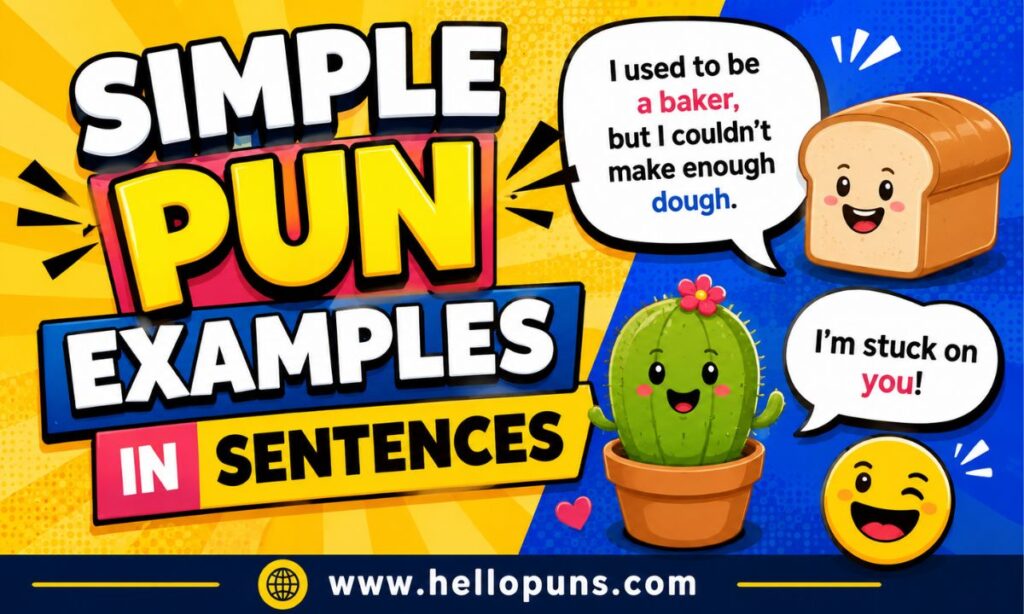
Simple Pun Examples in Sentences
Short and Easy Pun Sentences
- The fisherman was reel excited about the catch.
- I don’t trust stairs — they’re always up to something.
- The shoemaker was well-heeled after a great year in business.
- A well-read carpenter always knows the drill.
- My friend’s bakery business is always on a roll.
- The stationery shop is always drawing a crowd.
- I’m friends with 25 letters of the alphabet — I don’t know Y.
- A thief who stole a calendar got twelve months.
- The invisible man turned down the job — he just couldn’t see himself doing it.
- A few people were shocked when the power went out, but most took it in stride.
- The soldier who survived mustard gas and pepper spray is now a seasoned veteran.
- The magician got so mad he pulled his hair out, then pulled a rabbit out of it.
- The candle maker’s business only got brighter with time.
- The broom went into business because it was great at sweeping up deals.
- A pastry chef’s life is filled with second helpings of flour power.
Funny Pun Examples in Sentences
- Why don’t skeletons fight each other? They don’t have the guts.
- Two antennas got married. The wedding wasn’t much, but the reception was excellent.
- A cartoonist was found dead in his studio. Details are sketchy.
- The butcher backed into the meat grinder and got a little behind in his work.
- Why was the math book sad? It had too many problems.
- When his wife asked him to fix the wiring, the electrician said he was watt he does best.
- The novelist’s plot twist really turned the page on her career.
- Two silkworms had a race. It ended in a tie.
- The composer’s new symphony was in complete harmony with the orchestra’s mood.
- My friend’s job at the orange juice factory didn’t work out. He couldn’t concentrate.
- The photographer’s business finally developed after years of hard work.
- The dog groomer’s shop had a ruff start, but business is looking up now.
- A boxer’s favorite drink is punch.
- The gardener retired because his celery wasn’t good enough.
- My friend who fixes clocks says his job is really about time.
Question-and-Answer Pun Examples
- Q: Why did the coffee file a police report? A: It got mugged.
- Q: What do you call a fish wearing a bowtie? A: So-fish-ticated.
- Q: Why don’t eggs tell jokes? A: They’d crack each other up.
- Q: What do you call a bear with no teeth? A: A gummy bear.
- Q: Why did the picture go to jail? A: It was framed.
- Q: What do you call a factory that makes acceptable products? A: A satisfactory.
- Q: Why don’t oysters share? A: Because they’re shellfish.
- Q: What did the ocean say to the shore? A: Nothing, it just waved.
- Q: What do you call a belt made of watches? A: A waist of time.
- Q: Why did the man put his money in the freezer? A: He wanted cold, hard cash.
Types of Puns With Examples
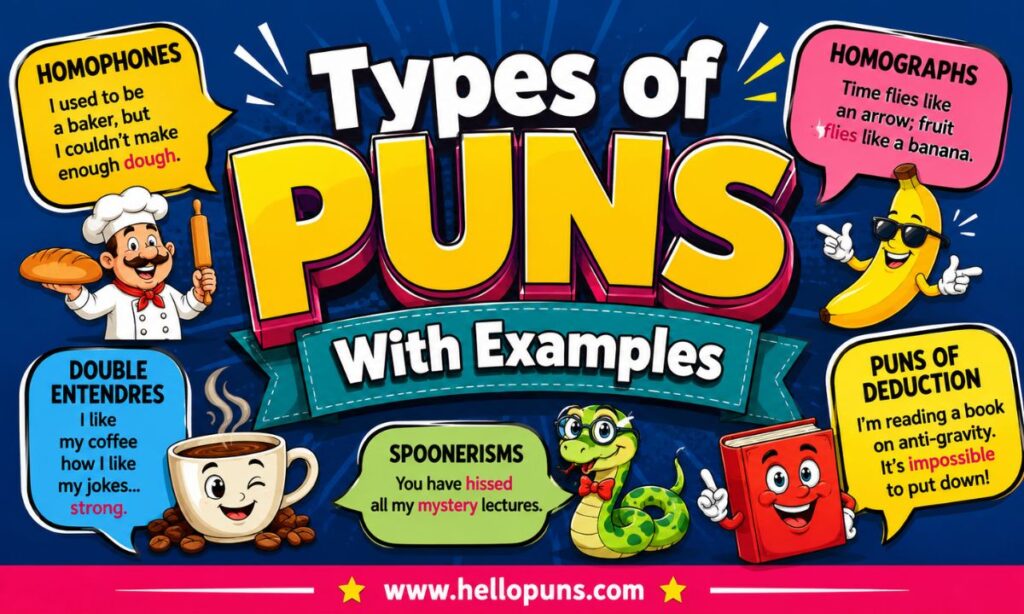
Puns are usually classified by how the double meaning is created. A short original visual-pun gallery lives on its own page; the type breakdown below focuses on the wordplay categories you’ll see most often.
Homophonic Pun Examples
Homophonic puns use two different words that sound alike but are spelled differently.
- The mushroom went to the party because he’s a real fungi (fun guy).
- The florist’s shop finally bloomed, but he had to leaf town after a bad harvest.
- The knight became a real night owl after his shift ended.
- The ghost’s favorite pie flavor is boo-berry.
- The sculptor’s new piece was pretty un-bearable — it was a statue of a grizzly.
- The astronaut’s favorite meal was launch.
- The pirate skipped school because he didn’t seas the point.
- The new donut shop had a hole lot of customers on opening day.
Homographic Pun Examples
Homographic puns use one spelling that carries two different meanings, often with a different pronunciation for each.
- She shed a tear when she saw the tear in her favorite dress.
- The musician plays bass, but on weekends he’d rather fish for bass.
- It takes a lot of wind to wind up an old clock on a windy day.
- The teacher had to lead the class through a lesson about lead pipes.
- The archer took a bow before tying a bow in her hair.
- He didn’t want to desert his friends in the desert.
- The bird dove into the lake right after the dove landed on the dock.
Homonymic Pun Examples
Homonymic puns use a single word, spelled and pronounced the same way, that carries two unrelated meanings.
- The bat flew out of the cave moments before the batter picked up his bat.
- The novelist couldn’t find the right note to end the chapter, so she played one on the piano instead.
- The boxer stepped into the ring right after receiving a ring from his fiancée.
- The teacher gave the class a pop quiz on how to open a can of pop.
- The carpenter couldn’t bear to look at the bear he’d carved from a log.
- The director loved to shoot every scene, but he never wanted to shoot the messenger who brought bad news.
- The runner had to duck under the fence to avoid stepping on a duck.
Compound Pun Examples
Compound puns stack two or more individual puns into a single line or joke.
- I used to be a baker, but I couldn’t make enough dough, so I decided to loaf around and use my noodle to make ends meet instead.
- The math teacher who lost her ruler still couldn’t measure up, and that was the last straw for the whole department.
- A pun about a fisherman would really reel you in and hook you, but I don’t want to carp about it too much.
- The tailor lost his job because he didn’t mind his own business, and he kept sewing seeds of doubt about the seams of the operation.
- The lumberjack couldn’t log his hours because he kept branching into other projects and barking up the wrong tree.
- The astronomer’s business never really took off, and now it’s just history among the stars.
- The chef whisked away his troubles by whisking eggs, then really scrambled to plate the dish before it got beaten by the clock.
Recursive Pun Examples
Recursive puns build on themselves — the punchline only lands once you’ve followed the wordplay set up earlier in the same joke. A widely cited textbook example: two explorers in a kayak lit a fire to stay warm, the kayak sank, which proves you can’t have your kayak and heat it too — a play on “you can’t have your cake and eat it too.”
- The tailor who altered pants for a living finally let his business out, and once it grew, he really took in the profits.
- The baker kneaded a break from the daily grind, so he loafed around, and honestly, that takes the cake for the best excuse we’ve heard.
- The clockmaker said business was about time, then added it was also running like clockwork, and finally admitted he was just watching the minutes tick by.
- The electrician said the job was shocking at first, but once he got charged up, it became a truly positive experience — currently, business is live.
- The farmer said the harvest was corny, but he couldn’t help stalking the fields for more material, and in the end, it was just a-maize-ing.
- The beekeeper said his job had its stings attached, but overall, business was just buzzing along — and that’s the long and short of the hive story.
Pun Examples by Topic
Animal Pun Examples
- The owl was a hoot at every party.
- The kitten’s favorite subject in school was mewsic.
- The snake became a lawyer because he was good at hiss-terical arguments.
- The frog parked illegally, so he got toad away.
- The rooster refused to fight because he didn’t want to ruffle any feathers.
- The cow’s favorite type of performance is moo-sical theater.
Food Pun Examples
- The tomato blushed because it saw the salad dressing.
- The grape stopped in the middle of the road because it ran out of juice.
- The steak restaurant refused to serve customers who couldn’t make the cut.
- The banana went to the doctor because it wasn’t peeling well.
- The lettuce won the race because it was ahead by a head.
- The cheese wasn’t in a sharing mood because it was feeling grate.
School and Work Pun Examples
- The new hire at the pencil factory was a real sharp thinker.
- The office’s new stapler became quite the binding presence in every meeting.
- The grammar teacher was known as a real noun-sense expert.
- The accountant lost his job because he couldn’t count on anyone anymore.
- The new violinist at the firm proved instrumental to the team’s success.
- The old printer refused to work until it got a little toner, loving care.
Science and Math Pun Examples
- The chemist kept his liquids locked up because he didn’t trust anyone else’s element of surprise.
- Geometry teachers are always right, because they never miss an angle.
- The physicist broke up with his girlfriend because there was no chemistry left.
- Why was six afraid of seven? Because seven ate nine.
- The statistician’s marriage was on the rocks, but on average, things were looking up.
- The astronomer refused to date anyone outside his solar system — he needed someone with real gravity in the relationship.
Love and Friendship Pun Examples
- My best friend and I are like jam on toast — we’re always in a jam together, but it’s sweet.
- The couple who ran a candle shop said their love really lit up the room.
- Two friends who owned a bakery said their friendship was the best thing since sliced bread.
- My friend who’s an electrician says our friendship has real current appeal.
- Two friends who both love the ocean say their bond only grows with the tide.
- The couple who owned a music shop said their love was always in tune.
Pun Examples in Literature
Puns in Shakespeare and Drama
In Romeo and Juliet, the wounded Mercutio jokes that if his friends ask for him tomorrow, “they shall find me a grave man” — playing on grave as both “serious” and “buried.”
In Julius Caesar, a cobbler introduces himself to a crowd of Roman citizens with a string of puns on his trade, joking that he is “a mender of bad soles,” using soles to suggest both shoe soles and souls.
Shakespeare’s Sonnet 135 repeats the word “Will” throughout, layering his own name with the everyday word for desire or intention — a pun scholars often cite as one of his most sustained.
Much Ado About Nothing takes its title from a pun: in Shakespeare’s day, “nothing” was pronounced similarly to “noting,” a word connected to the play’s themes of eavesdropping and gossip.
Shakespeare’s Love’s Labour’s Lost is frequently cited by scholars for its dense concentration of puns and wordplay among its courtly characters, more so than almost any other play in his canon.
Puns in Poetry and Prose
In Alice’s Adventures in Wonderland, Lewis Carroll’s Mock Turtle explains that his old teacher was called a Tortoise “because he taught us,” turning the animal’s name into a pun on instruction.
The Mock Turtle also lists his school subjects as “Drawling, Stretching, and Fainting in Coils” — a pun on the ordinary subjects Drawing, Sketching, and Painting in Oils.
Oscar Wilde built The Importance of Being Earnest around a title pun: the play’s central deception hinges on a man pretending to be named Ernest while trying to be, and be seen as, earnest.
In the Gospel of Matthew, Jesus tells Peter, “You are Peter, and on this rock I will build my church” — a pun recognized by biblical scholars on the Greek Petros (Peter) and petra (rock).
Benjamin Franklin is widely credited with the line “We must all hang together, or assuredly we shall all hang separately,” delivered at the signing of the Declaration of Independence, playing on hang as both “stick together” and “be executed.”
How to Explain a Literary Pun
To unpack a literary pun for a reader or student, name the word doing double duty, give its first meaning in context, give its second meaning, and note why the author likely chose it — for tone, characterization, or dramatic irony. Mercutio’s “grave man” pun, for example, works because it lets a dying character joke about his own death, using the wordplay to soften a tragic moment.
Pun Examples for Students
- The librarian said the mystery novel was a real page-turner because nobody could put it down.
- The lesson on fractions turned out to be a piece of cake once the class split it up.
- The new pencil sharpener was quite the point-taker in class discussions.
- The gym teacher said running laps was quite a stretch for everyone.
- The art teacher said drawing conclusions was harder than drawing pictures.
- The science class agreed the lesson on magnets was very attractive.
- The spelling bee champion said the final round was un-BEE-lievable.
- The geography teacher said learning about mountains gave the class a real peak into new material.
- The typing class agreed the new keyboards had a lot of character.
Identify the Pun: Mini Practice
For each sentence, name the word doing double duty and its two meanings.
- “The librarian said the mystery novel was a real page-turner because nobody could put it down.”
- “The science class agreed the lesson on magnets was very attractive.”
- “The geography teacher said learning about mountains gave the class a real peak into new material.”
Answers and Explanations
- Put down — literally setting a book down, and the idiom for stopping something you’re enjoying.
- Attractive — magnets that physically attract objects, and a lesson that’s interesting.
- Peak / peek — a homophone: mountain peak, and a brief look at something new.
Why Writers Use Puns
Humor and Surprise
A pun rewards attention. Because the second meaning arrives a beat after the first, puns create a small moment of surprise that lands as humor even in an otherwise plain sentence.
Memorable Headlines and Phrases
Headline writers and copywriters lean on puns because double meanings are easy to remember. A pun-based headline often sticks with a reader longer than a purely descriptive one, since the reader has to do a small amount of mental work to “get” it.
Characterization and Tone
In fiction and drama, characters who pun — like Mercutio or Shakespeare’s clowns — often read as quick-witted, playful, or subtly subversive. A well-placed pun can reveal intelligence or deflect tension without changing the plot.
Ambiguity and Multiple Meanings
Beyond humor, puns let writers pack two ideas into one phrase. A title like Much Ado About Nothing works on more than one level at once, giving the phrase more depth than a single, literal meaning would.
How to Create Your Own Puns
Choose a Word With Pun Potential
Start with a word connected to your topic that has more than one common meaning, or a word with an obvious homophone. Words tied to jobs, hobbies, or everyday objects — like interest, current, or note — tend to work well because their second meanings are widely known.
Find Homophones and Multiple Meanings
Once you have a candidate word, list its other meanings or any words that sound similar. For “current,” for example, there’s the electrical meaning and the “up to date” meaning — both usable depending on context.
Build a Clear Setup
Write a sentence that makes the first, literal meaning obvious. If the setup is confusing on its own, the pun won’t land, because the reader needs to understand the ordinary meaning before the twist can surprise them.
Place the Pun in the Punchline
Save the pun word for the end of the sentence or joke whenever possible. Readers process puns faster when the ambiguous word is the last thing they read, since it reframes everything that came before it.
Test and Rewrite the Pun
Read the line out loud to someone unfamiliar with it. If they need the pun explained, the setup likely needs to be clearer, or the word choice needs to be more common. Simple, familiar words usually make stronger puns than obscure ones.
When Puns Work — and When They Do Not
Good Places to Use Puns
Puns work well in headlines, social captions, light conversation, greeting cards, and any writing that already has a playful tone. They’re especially effective when the pun word is directly related to the topic at hand.
Common Pun-Writing Mistakes
- Choosing an obscure word that most readers won’t recognize.
- Forcing a pun into a serious or sensitive topic where it feels out of place.
- Explaining the pun in the same sentence, which kills the surprise.
- Stacking too many puns into one line, which makes the writing hard to follow.
Avoiding Forced or Confusing Wordplay
If a pun requires a lengthy explanation to make sense, it’s usually not ready to publish. A strong pun should be understandable within a second or two of reading it, without a footnote.
Quick Pun Editing Checklist
- Does the humor genuinely come from a double meaning or a homophone?
- Is the setup clear before the pun word appears?
- Would a reader unfamiliar with the topic still catch it?
- Is the tone appropriate for where it’s being used?
- Does it avoid being confused with a joke, rhyme, or ironic statement?
Frequently Asked Questions About Puns
What is a pun?
A pun is a figure of speech that creates humor or emphasis by using a word with more than one meaning, or two different words that sound alike.
What is a simple example of a pun?
“I used to be a banker, but I lost interest” is a simple pun, since interest means both curiosity and money earned from a bank.
What are the main types of puns?
The main types are homophonic (sound-alike words), homographic (same spelling, different pronunciation or meaning), homonymic (same spelling and pronunciation, different meaning), compound (multiple puns stacked together), and recursive (a pun that builds on an earlier one in the same joke).
Is a pun a figure of speech?
Yes. A pun is classified as a figure of speech and a literary device, specifically a form of wordplay known as paronomasia.
What is the difference between a pun and a joke?
A joke is any structured piece of humor with a setup and punchline. A pun specifically relies on double meaning or sound-alike words, and not every joke contains one.
What is the difference between a pun and a double entendre?
A pun’s humor comes from wordplay — sound or spelling. A double entendre’s humor comes from a phrase that can be read two ways in context, usually with one interpretation being suggestive.
Why do writers use puns?
Writers use puns to add humor, create memorable headlines and titles, reveal a character’s wit, or pack two meanings into a single phrase.
How can I create my own pun?
Pick a word connected to your topic with more than one meaning or a common homophone, build a clear setup around its literal meaning, and place the pun word at the end of the sentence for maximum surprise.

Hey, I’m Theo Banter. With over 4 years of experience in the world of digital storytelling and wordplay, I’ve dedicated my career to the art of the ‘perfect pun.’ I created this little corner of the internet where words love to play, turning simple ideas into clever lines that make readers smile. My mission is simple: if I can make you laugh (or at least groan!), I’ve done my job. Welcome to the freshest humor on the web